



What Is Onasadya? Traditional Onam Sadya Dishes, Serving & Significance
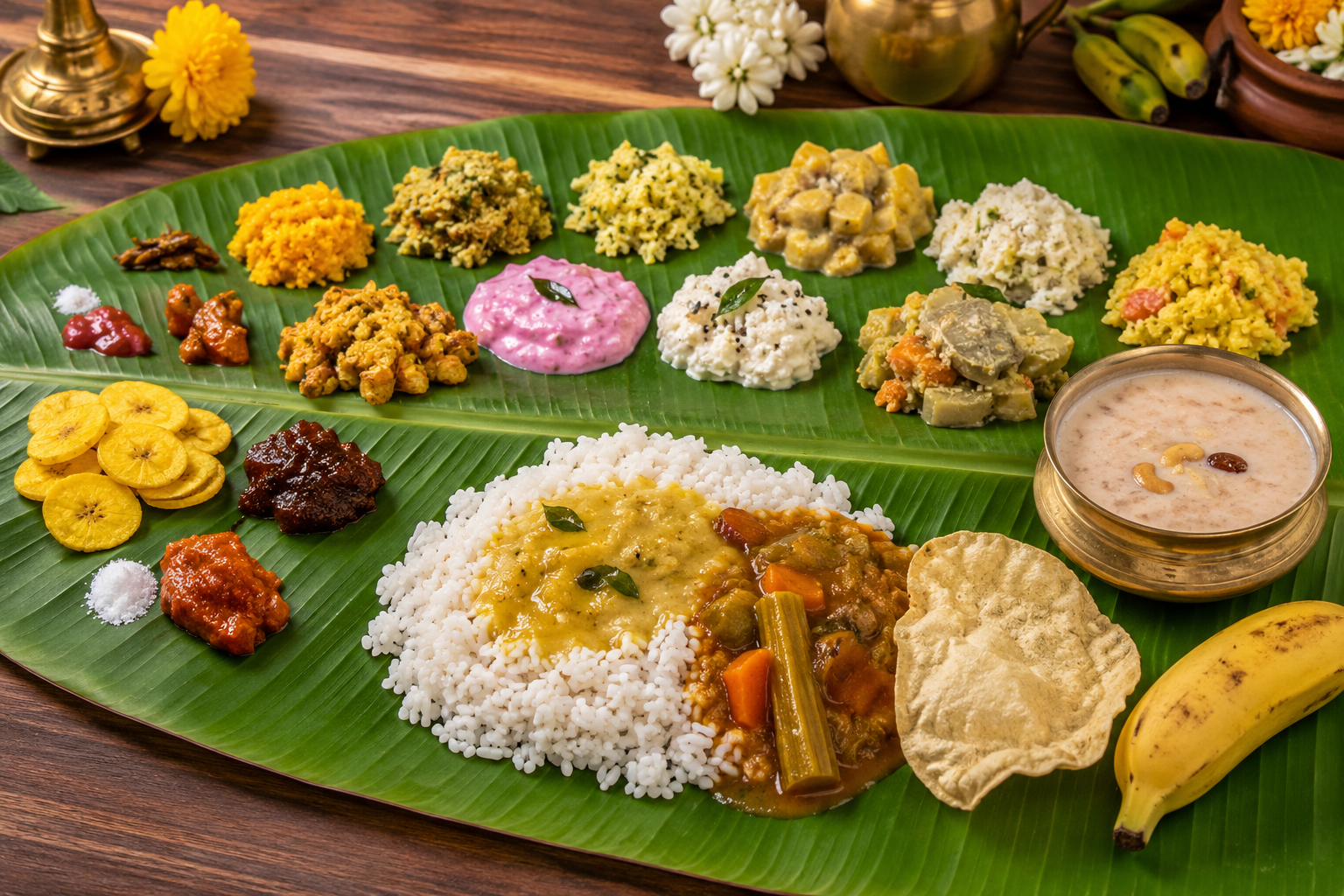
Onasadya is the traditional feast associated with Onam in Kerala, bringing together an elaborate selection of dishes served on a banana leaf. For many families, it is one of the most anticipated parts of the festival and an important part of celebrating Thiruvonam together.
But what exactly is served in an Onam Sadya? Why is the meal served on a banana leaf? Is there a particular order for serving the dishes? And does every Onasadya contain the same foods?
This guide explores what Onasadya is, its significance during Onam, common Sadya dishes, payasam varieties, traditional serving customs and regional variations across Kerala.
Quick answer: Onasadya, or Onam Sadya, is the festive meal traditionally associated with Onam in Kerala. It is generally served on a banana leaf and includes rice accompanied by a variety of vegetable preparations, curries, pickles, fried accompaniments and desserts such as payasam. The exact dishes, number of items and serving customs can vary by region, household and occasion.
What Is Onasadya?
Onasadya is the special Sadya prepared and served as part of the Onam celebrations, particularly on Thiruvonam.
Onasadya is also commonly written as Onam Sadya or Ona Sadya. These terms refer to the festive Sadya associated with Onam, although spelling and usage can vary in English.
The Malayalam word Sadya refers to a feast or banquet. Sadya is not exclusive to Onam; traditional Kerala Sadyas are also associated with weddings and other important celebrations. During Onam, however, the feast takes on a particularly important cultural role and is commonly referred to as Onasadya.
The meal brings together numerous flavours and textures through rice, vegetable dishes, lentil preparations, coconut-based curries, pickles, fried accompaniments and sweet desserts.
It is traditionally presented on a banana or plantain leaf rather than an ordinary dinner plate.
Onasadya is also deeply social. Preparing, serving and eating the meal together has traditionally brought family members and communities together during the festival.
If you are unfamiliar with the wider celebration, read our complete guide to Onam 2026 for an introduction to Thiruvonam, King Mahabali, Pookalam, Onasadya and other important traditions.
Why Is Onasadya Important During Onam?
Food plays an important role in festivals around the world, but Onasadya is more than simply a large festive lunch.
It represents celebration, abundance, hospitality and eating together.
Traditional Onam narratives centre on the annual return of the legendary King Mahabali to visit his people. Homes prepare for the occasion through traditions that can include cleaning and decorating, creating Pookalam, wearing festive clothes and preparing the Onam feast.
The scale of an Onasadya also reflects the celebratory nature of the occasion. Instead of a single curry and rice, numerous preparations are brought together on one banana leaf.
Importantly, there is no need to judge the authenticity of a family celebration purely by counting the number of dishes. The composition of a Sadya can vary according to region, household tradition, availability and the scale of the gathering.
Is Onasadya Vegetarian?
The traditional Kerala Sadya is generally understood as a vegetarian feast. The classic spread consists primarily of rice, vegetables, pulses, coconut-based preparations, curd-based dishes, pickles, fried accompaniments and desserts.
However, food traditions across Kerala are not completely uniform.
Kerala Tourism documents regional variations in Onasadya and notes that meat and seafood can form part of Onam meals in some parts of northern Kerala, including particular traditions in Kannur.
So it is more accurate to describe the classic or widely recognised Sadya as vegetarian while acknowledging that local Onam food customs can differ.
Cultural note: There is no single Onasadya menu followed identically throughout Kerala. Dishes, preparation methods and even some serving customs can vary between northern, central and southern Kerala and between individual families.
Why Is Onasadya Served on a Banana Leaf?
One of the most recognisable features of a Sadya is the large green banana or plantain leaf on which the meal is presented.

The leaf provides enough surface area for rice as well as the numerous smaller portions of curries, pickles, vegetable preparations and accompaniments that make up the feast.
But the banana leaf is not simply a substitute for a plate. It is part of the traditional presentation of Sadya itself.
Kerala Tourism describes the leaf as being positioned with its narrow or tapering end towards the left of the person eating. Different dishes then occupy different areas of the leaf, while rice is generally served on the lower portion closer to the diner.
The bright colours of the dishes against the fresh green leaf also make the finished Sadya visually distinctive.
What Dishes Are Served in an Onasadya?
The exact menu varies, but a traditional Onasadya can bring together a remarkable variety of dishes.
Common components include:
- Rice
- Parippu
- Sambar
- Avial
- Thoran
- Olan
- Erissery
- Kaalan
- Kootu Curry
- Pachadi
- Kichadi
- Rasam
- Moru or other curd/buttermilk preparations
- Ginger, mango and lime pickles
- Banana chips
- Sharkara Varatti
- Pappadam
- Payasam or Pradhaman
This is best understood as a guide to commonly associated dishes rather than a compulsory checklist.
Traditional Onasadya Dishes Explained
If you have never eaten a Sadya before, the names alone may not tell you what is actually on the banana leaf.
Here are some of the best-known components.
| Dish | What It Is | Role in the Sadya |
|---|---|---|
| Parippu | A lentil preparation, traditionally eaten with rice and ghee. | Commonly begins the rice-based courses. |
| Sambar | A lentil and vegetable curry whose preparation can vary regionally. | One of the principal curries served with rice. |
| Avial | A mixed-vegetable preparation typically incorporating coconut. | One of the best-known Sadya side dishes. |
| Thoran | A relatively dry vegetable preparation commonly made with grated coconut. | Adds a drier vegetable texture to the meal. |
| Olan | A mild preparation traditionally made with ingredients such as ash gourd, cowpeas and coconut milk. | Provides a comparatively gentle flavour among stronger dishes. |
| Erissery | A vegetable preparation that can include ingredients such as yam, plantain or pumpkin, depending on the recipe. | A traditional component with regional variations. |
| Kaalan | A thick, tangy curd-based preparation commonly made with vegetables such as yam or plantain. | Adds a distinctive sour and creamy element. |
| Pachadi | A curd-based preparation that may use ingredients such as pineapple, mango or pumpkin. | Can introduce sweet, tangy and cooling flavours. |
| Kichadi | Another curd-based preparation, with ingredients varying by recipe and region. | Provides a cooling contrast to stronger flavours. |
| Rasam | A thinner, tangy and spiced preparation. | Typically appears during the later part of the meal. |
What Are the Crispy and Pickled Items in an Onasadya?
Not everything on a Sadya leaf is a curry.
The smaller accompaniments are important because they introduce contrasting textures and concentrated flavours.
Upperi or Banana Chips
Thin, crisp banana chips are one of the most recognisable accompaniments.
Sharkara Varatti
This is a sweet preparation of banana pieces coated with jaggery and spices, offering a very different flavour from ordinary banana chips.
Pappadam
Crisp pappadam provides a crunchy contrast to rice and curries.
Pickles
Mango and lime pickles are among the varieties commonly associated with Sadya.
Inji Curry or Puli Inji
Ginger-based preparations provide an intense combination of tangy, sweet and spicy flavours in a relatively small serving.
Because many of these accompaniments have strong flavours, only modest portions are needed on the banana leaf.
What Is Payasam in Onasadya?
Payasam is the sweet course of the Sadya and one of the most eagerly anticipated parts of the feast.

There is no requirement that every Onasadya serve exactly one type of payasam. Large celebrations may offer multiple varieties.
Some commonly associated varieties include:
Ada Pradhaman
A rich traditional dessert made using ada, jaggery and coconut-based ingredients.
Palada Payasam
A milk-based payasam prepared with ada and known for its creamy character.
Parippu Payasam
A lentil-based sweet preparation commonly made with jaggery and coconut milk.
Semiya Payasam
A vermicelli-based payasam that is familiar across many celebrations.
Other varieties are also prepared for Onasadya.
Good to know: “Payasam” is not one single fixed dessert. An Onasadya may include one or several varieties prepared using different bases such as ada, milk, lentils or vermicelli.
How Is an Onasadya Traditionally Served?
The placement and sequence of Sadya dishes are part of the traditional dining experience.

Although exact customs can vary, several broad principles are widely associated with traditional serving.
1. Position the Banana Leaf
The tapering end of the banana leaf is traditionally placed towards the diner's left.
2. Serve the Smaller Accompaniments
Items such as chips, pickles and vegetable preparations are arranged in their respective areas of the leaf.
3. Serve Rice
Rice occupies the larger lower area of the leaf, closer to the person eating.
4. Begin the Rice Courses
Parippu with ghee traditionally forms one of the opening combinations, followed by courses involving curries such as sambar.
5. Continue Through the Different Flavours
The meal progresses through combinations of rice, curries and accompaniments rather than requiring every item to be mixed together at once.
6. Enjoy Payasam
One or more sweet payasams form an important part of the feast.
7. Finish With Later Courses
Depending on the local custom, preparations such as rasam, curd-based dishes or buttermilk may appear towards the later part of the meal.
The important point for a first-time diner is not to become anxious about memorising every step. Observe how the meal is being served and enjoy each course as it arrives.
Where Does Each Dish Go on the Banana Leaf?
A Sadya leaf may look almost like a carefully organised palette of food once all the accompaniments have been served.
Traditional serving assigns particular areas of the leaf to different dishes.
In broad terms:
- Rice occupies the large lower area closer to the diner.
- Smaller vegetable dishes and accompaniments are arranged along the upper portion.
- Pickles and strongly flavoured items occupy relatively small areas.
- Chips and other dry accompaniments are placed separately.
Exact placement traditions can vary, so a single diagram should not be treated as the only correct arrangement throughout Kerala.
How Many Dishes Are There in an Onasadya?
There is no universally fixed number of dishes that every Onasadya must contain.
This is worth emphasising because Sadya is frequently described online using a particular number — 20, 24, 26, 28, 40 or even more.
In practice, the number depends on the occasion, region, household and scale of the feast.
Kerala Tourism itself documents Sadyas of different sizes. A large ceremonial or temple feast can contain considerably more preparations than a practical family Onasadya prepared at home.
Rather than focusing exclusively on the number, it is more useful to understand the structure of the meal: rice, curries, vegetable preparations, pickles, fried accompaniments and sweet dishes come together to create the Sadya experience.
Does Onasadya Differ Across Kerala?
Yes — and this is one of the most interesting aspects of the tradition.
Kerala's food culture changes as you travel between southern, central and northern parts of the state, and Onasadya reflects some of those differences.
Kerala Tourism documents variations involving dishes such as sambar, kichadi, kaalan, pulissery, erissery and kootu curry.
For example, particular curd-based preparations may be more prominent in some regions, while certain vegetable dishes have stronger associations with others.
Payasam preferences and the foods eaten alongside them can also differ.
Even within the same region, two families may prepare their Onasadya differently because recipes and customs are often passed down through generations.
Keep in mind: When you encounter two different “traditional Onasadya menus,” that does not automatically mean one is incorrect. Kerala has significant regional and household variation, and traditional food practices are not completely standardised.
What Is the Connection Between Pookalam and Onasadya?
Pookalam and Onasadya are very different traditions, but both have become strongly associated with the visual and cultural identity of Onam.
Pookalam brings fresh flowers and floral patterns into the celebration, while Onasadya brings family and guests together around the festive meal.
Both also reflect preparation and participation.
A Pookalam may involve collecting, sorting and arranging flowers together. Preparing a large Sadya traditionally involves planning ingredients, cooking numerous dishes and coordinating the serving of the meal.
If you would like to explore the floral side of the festival in greater detail, read our guide to traditional Onam Pookalam flowers, flower names and decoration ideas.
Onasadya at Home vs Large Community Celebrations

Not every Onasadya needs to resemble a temple feast or a large restaurant spread.
A family celebrating at home may prepare a more manageable menu containing the dishes that matter most to their household.
A community celebration, on the other hand, may involve large-scale cooking and coordinated teams of people serving many diners.
Temple Sadyas can have their own customs and menus. Kerala Tourism, for example, documents Onasadya traditions at temples including Guruvayoor and Thrikkakara.
The scale may change dramatically, but eating together remains central to the experience.
Experiencing Your First Onasadya: Practical Tips
If you have been invited to an Onasadya for the first time, there is no need to feel intimidated by the number of dishes.
Follow the Host
If you are uncertain about a serving or eating custom, observe the people around you or simply ask your host.
Try Small Portions First
With numerous dishes available, small initial portions allow you to taste more of the meal without becoming full too early.
Expect Contrasting Flavours
A Sadya deliberately brings together different experiences — mild, spicy, tangy, sour, sweet and creamy preparations can all appear on the same leaf.
Don't Rush to Mix Everything
The meal is generally experienced through different combinations and courses. Allow the serving sequence to guide you.
Leave Room for Payasam
If several varieties are being served, the dessert portion of the meal can itself become quite substantial.
Frequently Asked Questions About Onasadya
What is Onasadya?
Onasadya is the festive Sadya traditionally associated with Onam in Kerala, particularly Thiruvonam. It is generally served on a banana leaf and includes rice, vegetable preparations, curries, pickles, fried accompaniments and sweet dishes such as payasam.
Is Onasadya vegetarian?
The classic Kerala Sadya is a vegetarian feast. However, Onam food customs are not identical throughout Kerala, and Kerala Tourism documents regional traditions in parts of northern Kerala where meat or seafood may also form part of Onam meals.
How many dishes are served in an Onasadya?
There is no single compulsory number of Onasadya dishes. The size of the feast varies by household, region and occasion. Large ceremonial Sadyas may contain many more dishes than a family meal prepared at home.
Why is Onasadya served on a banana leaf?
Serving Sadya on a banana or plantain leaf is part of Kerala's traditional dining custom. The large leaf provides space for rice and the numerous accompaniments, while different dishes are traditionally assigned particular areas of the leaf.
What are the main dishes in an Onam Sadya?
Common Onasadya dishes include rice, parippu, sambar, avial, thoran, olan, erissery, kaalan, pachadi, kichadi, rasam, pickles, banana chips, Sharkara Varatti, pappadam and one or more varieties of payasam. Menus vary between regions and families.
What dessert is served during Onasadya?
Payasam or Pradhaman is the traditional sweet component of Sadya. Varieties can include Ada Pradhaman, Palada Payasam, Parippu Payasam and Semiya Payasam, among others.
When is Onasadya eaten?
Onasadya is especially associated with Thiruvonam, the principal day of the Onam festival. Sadya as a wider Kerala tradition is also served for other festivals, weddings and important celebrations.
Are all Onasadya menus the same?
No. Onasadya dishes and recipes vary across Kerala and between households. Regional preferences, family traditions, ingredient availability and the size of the celebration can all influence the final menu.
More Than a Festive Meal
It is easy to describe Onasadya simply by listing its dishes, but doing so misses much of what makes the tradition significant.
The banana leaf, the many small servings, the preparation that begins before guests sit down, the people serving the meal and the family members eating together are all part of the experience.
Some families prepare an enormous spread. Others celebrate with a smaller selection of favourite dishes. Regional recipes add another layer of variation.
There is therefore no need for an Onasadya to pass a numerical test of authenticity.
Its enduring importance comes from something much simpler: sharing a celebratory meal as part of Onam.
Together with traditions such as Pookalam and the remembrance of Mahabali's homecoming, Onasadya helps make Onam a festival experienced not only through stories and decorations, but through food, hospitality and time spent together.
Sources & Further Reading
The cultural and culinary information in this guide has been cross-checked against resources published by Kerala Tourism, Department of Tourism, Government of Kerala. Onasadya menus and customs vary by region and household, so the dishes and serving practices described here should be understood as representative rather than universal.
- Kerala Tourism – Onasadya
- Kerala Tourism – Sadya Serving Guidelines
- Kerala Tourism – What Is Kerala Sadya?
- Kerala Tourism – Traditional Kerala Sadya

About Bloomsy Editorial Team
The Bloomsy Editorial Team creates practical content about flowers, gifting and important celebrations in India. Our festival guides aim to help readers understand the traditions surrounding occasions as well as the role flowers and gifting can play in modern celebrations.
For cultural topics such as Onam, we distinguish widely recognised traditions from regional and household variations and consult authoritative sources where appropriate.
This guide was prepared using Kerala Tourism resources for cultural and culinary references. Individual Onasadya traditions may differ between families and regions of Kerala.



 Delhi
Delhi Bangalore
 Mumbai
 Hyderabad
 Gurgaon
 Pune
Pune Chennai
 Kolkata