



Onam Pookalam Flowers: Traditional Flowers, Names & Decoration Ideas
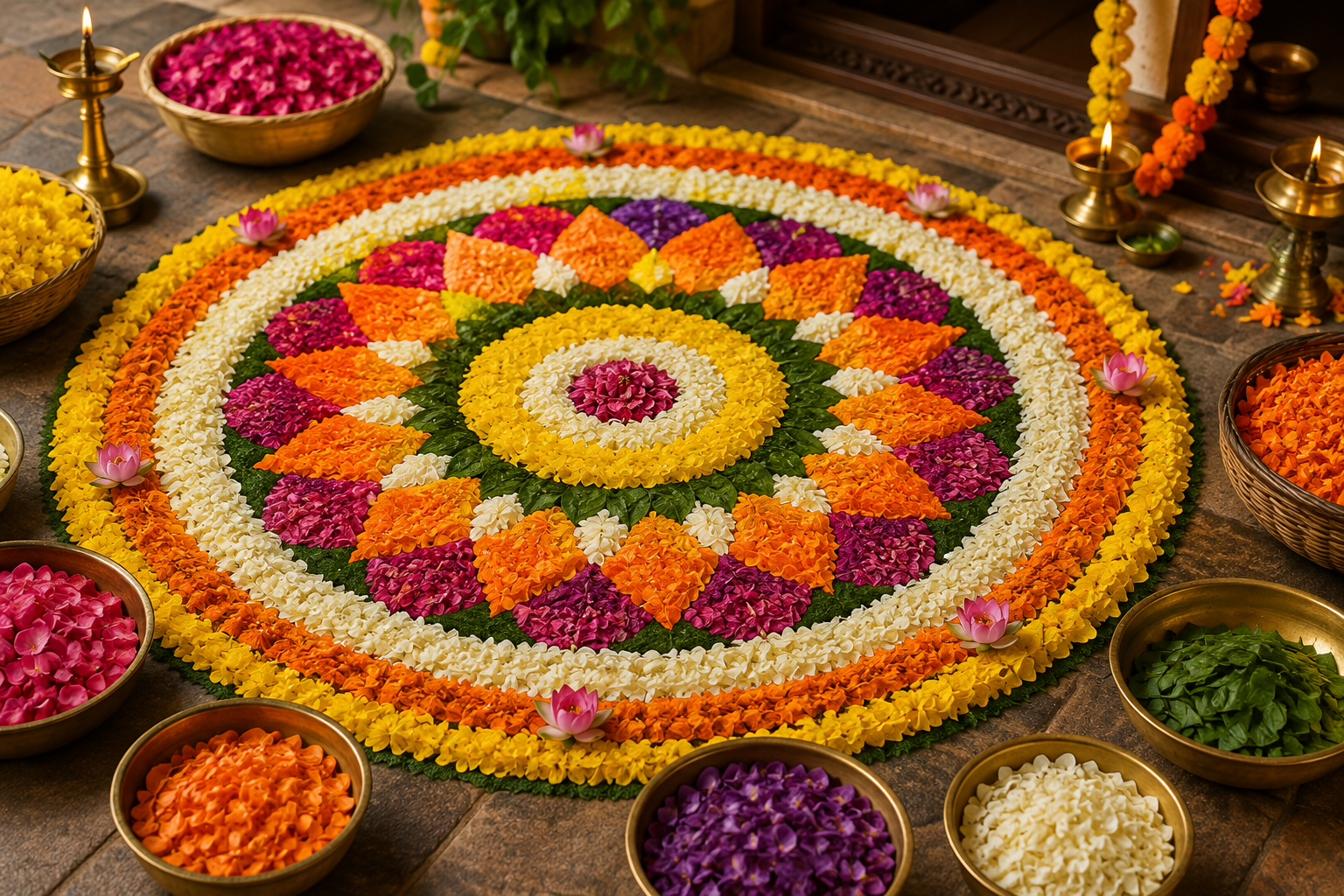
Pookalam flowers are an essential part of traditional Onam celebrations in Kerala. Historically, families created these colourful floral carpets using locally available flowers such as Thumba, Chethi, Chemparathy, Sankhupushpam, Jamanthi, Kongini and Mukuthi. Today, traditional flowers are often combined with marigolds, roses and other readily available blooms to create colourful Onam Pookalams.
But which flowers are traditionally used for Pookalam? Does every flower have to be traditional? And how should you choose flower colours when creating a Pookalam at home?
This guide explains the traditional flowers used for Onam Pookalam, their commonly known names, colours, how Pookalam flower traditions developed, and practical decoration ideas for creating your own floral arrangement.
Quick answer: Traditional Onam Pookalam flowers include Thumba, Tulasi, Chethi, Chemparathy, Sankhupushpam, Jamanthi, Mandaram, Kongini, Hanuman Kereedam and Mukuthi. Traditionally, families used flowers available locally in Kerala. Modern Pookalams also commonly use marigolds, roses and other colourful seasonal flowers depending on availability.
What Are Pookalam Flowers?
Pookalam flowers are the fresh flowers and petals used to create the decorative floral carpet associated with Onam.
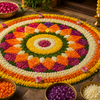
A Pookalam, also known as Athapookalam or Onapookalam, is traditionally created on the floor or ground, commonly near the entrance or courtyard of a home.
The tradition begins with Atham, the first of the ten important days leading to Thiruvonam.
According to Kerala's traditional Onam customs, Pookalams are associated with welcoming the legendary King Mahabali during his annual homecoming. The floral carpet has consequently become one of the most recognisable symbols of Onam.
If you are new to the festival, our complete guide to Onam 2026 explains the wider traditions of Onam, including Pookalam, Onasadya, gifting and the story of King Mahabali.
Which Flowers Are Traditionally Used for Onam Pookalam?
Traditional Pookalams were created primarily from flowers growing locally in Kerala rather than from flowers purchased specifically to match a predetermined design.

Some of the flowers associated with traditional Pookalam-making include:
- Thumba – Ceylon Slitwort
- Tulasi – Holy Basil
- Chethi – Flame of the Woods / Ixora
- Chemparathy – Hibiscus
- Sankhupushpam – Butterfly Pea
- Jamanthi – commonly associated with chrysanthemum/marigold usage in Pookalam traditions
- Mandaram – traditionally identified with Bauhinia acuminata in Kerala Tourism's Pookalam references
- Kongini – Lantana
- Hanuman Kereedam – Red Pagoda Flower
- Mukuthi – Tridax procumbens
Flower names can vary locally, and common names may refer to plants differently across regions. For that reason, when recreating a traditional Pookalam outside Kerala, it is often more practical to focus on the overall floral tradition rather than trying to reproduce an exact botanical list.
Traditional Pookalam Flowers at a Glance
| Traditional Name | Common Identification | Typical Colour | Useful in Pookalam For |
|---|---|---|---|
| Thumba | Ceylon Slitwort | White | Traditional simple arrangements and light sections |
| Chethi | Ixora / Flame of the Woods | Red, orange or related shades | Bright borders and contrasting sections |
| Chemparathy | Hibiscus | Commonly red | Bold accents and colourful sections |
| Sankhupushpam | Butterfly Pea | Blue or blue-purple | Contrasting details and darker accents |
| Kongini | Lantana | Multiple colours | Colour variation and small detailed sections |
| Hanuman Kereedam | Red Pagoda Flower | Red | Strong decorative accents |
| Mukuthi | Tridax procumbens | White and yellow | Natural-looking lighter details |
The table is intended as a practical reference rather than a strict recipe. Traditional Pookalam-making varies between households and regions, and the flowers available locally have always influenced the final design.
Why Is Thumba Important in Traditional Pookalam?
Thumba is particularly closely associated with the beginning of the traditional Pookalam.

Kerala Tourism describes the first-day Atham Pookalam as traditionally being a simple arrangement using Thumba flowers.
Thumba is a small white flower, so its visual appearance is very different from the enormous, intensely colourful Pookalams commonly seen in modern competitions and social-media photographs.
This difference tells us something important about the tradition.
The earliest Pookalams were not necessarily designed to be spectacular displays. They developed gradually as Onam approached.
Traditional detail: Kerala Tourism notes that a simple Pookalam using Thumba is associated with Atham, while additional colours and flowers are introduced as the festival progresses. The arrangement generally becomes larger towards Uthradam and Thiruvonam.
How Does the Pookalam Change During the Days of Onam?
Pookalam is traditionally not a decoration created once and left unchanged throughout Onam.
It develops along with the festival.

Atham
A simple floral arrangement traditionally begins on Atham. Thumba has a particularly strong association with the first day's Pookalam.
Chithira
Additional flowers are introduced as the design begins to develop. Traditional accounts describe white flowers being added around this stage.
Chothi and the Following Days
Brighter flowers and additional colours can gradually enter the arrangement, making the Pookalam more elaborate.
Moolam
One interesting traditional variation described by Kerala Tourism is the Moolakkalam, a square-shaped Pookalam associated with Moolam.
Uthradam
Traditionally, one of the largest and most elaborate Pookalams is prepared around Uthradam as the festival reaches its culmination.
Thiruvonam
Thiruvonam is the principal day of the festival and the culmination of the preparations for welcoming Mahabali.
Practices differ between regions and households, so these traditions should not be treated as a rigid design rule that every modern Pookalam must follow.
Do You Have to Use Only Traditional Flowers for Pookalam?
No. A modern Pookalam does not have to contain only traditional Kerala flowers.
Historically, families largely used flowers that were naturally and locally available. Modern availability is very different.
Some traditional wild and native flowers are now less commonly available, particularly for people living in cities or outside Kerala.
As a result, modern Pookalams frequently use flowers purchased from flower markets and florists.
Common modern choices can include:
- Marigolds
- Chrysanthemums
- Roses and rose petals
- Hibiscus
- Gerberas
- Jasmine and other small white flowers
- Locally available yellow, orange, red, pink, purple and white flowers
Kerala's flower markets themselves reflect this change. Modern Onam celebrations now use flowers brought into Kerala from neighbouring flower-growing regions in addition to locally grown varieties.
Practical rule: If traditional flowers are available, including some of them can connect your Pookalam more closely with the older custom. If they are not available, use fresh local flowers in complementary colours rather than avoiding the tradition altogether.
Best Flower Colours for an Onam Pookalam
A successful Pookalam is not simply about using as many colours as possible.
Contrast, repetition and clearly defined sections usually make the design easier to recognise.

Yellow
Yellow is one of the most familiar colours in modern Pookalam designs.
Yellow flowers work particularly well for large rings, backgrounds and borders because their brightness helps the design stand out.
Orange
Orange works naturally beside yellow while still creating enough contrast to define a separate pattern.
Marigold petals make orange especially easy to use in many modern Pookalams.
White
White is extremely useful for separating stronger colours.
A narrow white ring between orange and red, for example, can make both colours appear more clearly defined.
Red and Pink
Red and pink flowers work well as accent colours, particularly around the centre or within repeated geometric patterns.
Purple and Blue
Darker shades can provide strong contrast against yellow, orange and white.
Because naturally blue flowers may be less readily available, purple is often a practical alternative when designing a modern Pookalam.
Green
Leaves can create borders or define the outer edge of the arrangement.
Use greenery selectively so that it complements rather than overwhelms the floral design.
Simple Pookalam Colour Combinations
If you are creating a Pookalam for the first time, choosing the colour palette before buying or collecting flowers makes the process much easier.
Classic & Bright
Yellow + Orange + White
A simple combination that creates strong, clean rings and works well for beginners.
High Contrast
Yellow + Red + White + Green
Useful for geometric designs where individual sections need to remain clearly visible.
Colourful
Yellow + Orange + Pink + Purple + White
A vibrant palette suited to larger contemporary Pookalams.
Natural
White + Yellow + Green + Small Red Accents
A restrained palette that works well for smaller home arrangements.
How to Choose Flowers for Your Pookalam
The prettiest flower in a bouquet is not automatically the best flower for a Pookalam.
Because Pookalams are constructed from many small floral sections, practical characteristics matter.
1. Choose Flowers With Usable Petals
Flowers that can be separated into petals are convenient when filling larger sections.
Marigolds, chrysanthemums and roses are commonly useful for this purpose.
2. Keep Some Small Flowers Whole
Not every flower needs to be broken into petals.
Small whole flowers can create attractive borders, central details and repeating patterns.
3. Look for Strong Colour Contrast
Two flowers may look beautiful individually but disappear into each other if their colours are too similar.
Plan neighbouring sections so that there is sufficient contrast.
4. Consider How Much Area You Need to Cover
A large Pookalam can require considerably more flowers than expected.
Use abundant, easily separated flowers for large sections and reserve less plentiful varieties for accents.
5. Choose Fresh Flowers
Fresh petals generally retain their shape, texture and colour better throughout the celebration.
Avoid flowers that are already browning, bruised or heavily wilted.
How Many Flowers Do You Need for a Pookalam?
There is no single quantity because the requirement depends on the diameter, number of rings, density of petals and flower varieties used.
A small apartment Pookalam may require only a modest amount of flowers, while a large community or competition design can consume many times that quantity.
Instead of buying equal quantities of every flower, plan the design first.
Identify:
- the dominant background colour
- the second-largest colour area
- border colours
- small accent colours
Buy more of the flowers used for large rings and less of expensive or limited flowers used only for details.
This approach usually reduces both shortages and unnecessary waste.
How to Prepare Flowers Before Making a Pookalam
Preparing the flowers before you begin can make Pookalam-making considerably easier.

Separate Flowers by Colour
Place yellow, orange, white, red, pink and other colours into separate bowls or containers.
Separate Petals Carefully
For flowers being used as loose petals, remove damaged or discoloured pieces while separating them.
Keep Whole Flowers Separate
If you plan to use whole flowers for borders or the centre, set these aside before processing the remaining blooms.
Prepare Leaves Separately
If your design includes a green outer border, prepare the leaves separately so they do not become mixed with flower petals.
Work as Close to Decoration Time as Practical
Avoid preparing delicate petals unnecessarily early. The fresher the material, the better the finished Pookalam generally looks.
Easy Onam Pookalam Decoration Ideas
You do not need an intricate competition design to create an attractive Pookalam at home.

1. Concentric Circle Pookalam
This is one of the easiest approaches for beginners.
Start with a small circular centre and add rings of contrasting colours around it.
For example:
Yellow centre → white ring → orange ring → red accents → yellow outer border.
2. Flower-Shaped Pookalam
Create a circular centre and build large petal-shaped sections around it.
Use contrasting colours between neighbouring petals to keep the flower shape visible.
3. Star Pookalam
Draw a simple star inside a circle and fill the points with alternating colours.
A white or yellow background can help darker star sections stand out.
4. Small Apartment Pookalam
For apartments or homes with limited entrance space, create a compact Pookalam rather than trying to reproduce a large courtyard design.
Three or four well-defined rings can look more attractive than a complicated design squeezed into a small area.
5. Traditional-Inspired Pookalam
Instead of focusing entirely on symmetry and size, use locally available flowers and keep the arrangement relatively simple.
This approach reflects the older practice of creating Pookalams from flowers available around the household and local landscape.
6. Floating Flower Decoration
If floor space is unavailable, flower petals can also be arranged decoratively in an uruli or another suitable traditional bowl with water.
This is better understood as an Onam-inspired floral decoration rather than a replacement for the traditional floor Pookalam, but it works particularly well for apartment interiors, dining areas and entrance tables.
How to Make Your Pookalam Look Neater
A few simple techniques can make even a beginner's Pookalam look considerably more polished.
- Draw the outline first. Lightly marking circles or geometric sections helps maintain symmetry.
- Work from the centre outward. This reduces the chance of disturbing completed sections.
- Create clean borders. Thin contrasting rings make neighbouring colours easier to distinguish.
- Use petals of similar size within each section. This produces a more even texture.
- Fill gaps gradually. Do not pile flowers too densely at the beginning.
- Keep spare petals. Use them at the end to correct thin or uneven areas.
Beginner tip: A simple Pookalam with four clean, contrasting colour sections will usually look better than a highly complicated design with uneven lines. Start simple and add detail only if you have enough flowers, space and time.
Can You Make a Pookalam Outside Kerala?
Absolutely.
Onam is celebrated by Malayali families and communities throughout India and around the world.
You may not have access to every traditional Kerala flower, but you can still preserve the essential character of the tradition by using fresh, locally available flowers.
In fact, adapting to locally available flowers is consistent with the historical practicality of Pookalam-making, when households largely relied on flowers growing nearby.
If you live in Mumbai, Bengaluru, Delhi, Hyderabad, Pune or another major Indian city, choose flowers that are fresh and easily available locally rather than transporting rare varieties simply to reproduce a photograph.
Pookalam Flowers vs Flowers for Onam Gifting
Although flowers are important to both, Pookalam flowers and Onam flower gifts serve different purposes.
For Pookalam-making, you generally want loose flowers or petals that can be separated, arranged densely and used to fill patterns.
For gifting, presentation becomes more important. A bouquet, basket or vase arrangement is designed to be received and displayed rather than dismantled into petals.
| Purpose | Best Flower Format | What Matters Most |
|---|---|---|
| Pookalam | Loose flowers and petals | Colour, quantity, freshness and ease of arranging |
| Onam Gifting | Bouquets, baskets and floral arrangements | Presentation, recipient preference and delivery suitability |
| Home Decoration | Loose flowers, arrangements or both | Available space, décor style and longevity |
If you want to send a floral gift rather than flowers for making a Pookalam, explore Bloomsy's Onam flowers.
What to Do With Leftover Pookalam Flowers
It is easy to buy more flowers than your final design requires.
Instead of discarding usable blooms immediately, consider using the remaining flowers for:
- small entrance decorations
- an uruli flower arrangement
- decorating the dining area for Onasadya
- small floral bowls around the home
- adding fresh flowers around lamps or festive décor where safe
Keep flowers and loose petals a safe distance from open flames.
Once the flowers have wilted, dispose of them responsibly according to the composting or organic-waste facilities available where you live.
Frequently Asked Questions About Onam Pookalam Flowers
Which flowers are traditionally used for Onam Pookalam?
Traditional Onam Pookalam flowers include Thumba, Tulasi, Chethi, Chemparathy, Sankhupushpam, Jamanthi, Mandaram, Kongini, Hanuman Kereedam and Mukuthi. Traditionally, families primarily used flowers that were locally available in Kerala.
What is the most traditional flower used for Pookalam?
Thumba is particularly closely associated with traditional Pookalam-making. Kerala Tourism describes a simple Pookalam using Thumba flowers on Atham, the first day of the traditional Onam period.
Can marigold be used for Onam Pookalam?
Yes. Marigolds are widely used in modern Pookalams because their yellow and orange petals provide strong colour and are practical for filling larger sections. Modern Pookalams often combine traditional and readily available flowers.
Can roses be used in Pookalam?
Yes. Rose petals are commonly suitable for modern Pookalams, particularly for red, pink, white or yellow accents. Roses are not required for a traditional Pookalam but can be used when locally available.
When do people start making Pookalam for Onam?
Pookalam-making traditionally begins on Atham, the first of the ten important days leading to Thiruvonam. The floral design generally develops and becomes more elaborate as Onam progresses.
Does a Pookalam have to be circular?
No. Circular Pookalams are common, but designs can vary. Kerala Tourism also documents the square-shaped Moolakkalam associated with Moolam, and contemporary Pookalams use many geometric and artistic patterns.
Can I make a Pookalam if traditional Kerala flowers are unavailable?
Yes. Use fresh flowers available locally and choose contrasting colours that suit your design. Historically, Pookalams themselves relied heavily on locally available flowers, so adapting to local availability is practical and consistent with the spirit of the tradition.
What colours are best for a Pookalam?
Yellow, orange, white, red, pink, purple and green can all work well. For beginners, yellow, orange and white provide a simple high-contrast combination that is easy to arrange into clearly defined rings.
Keeping the Pookalam Tradition Alive
A spectacular Pookalam can involve thousands of petals and hours of careful work, but size is not what gives the tradition its meaning.
The older practice was closely connected with the flowers people could find around them. Families gathered flowers, created the arrangement together and gradually developed the Pookalam as Onam approached.
Modern life has changed how flowers are sourced. Many people live in apartments, traditional varieties can be difficult to find, and flowers may now come from markets hundreds of kilometres away.
Yet the central idea remains remarkably accessible.
Choose fresh flowers. Gather the people you celebrate with. Start with a simple design. Let children participate even if their section is not perfectly symmetrical.
A small Pookalam made together can carry considerably more meaning than an elaborate arrangement created only for appearance.
And that is perhaps one of the reasons the floral tradition continues to remain such a recognisable and loved part of Onam.
Sources & Further Reading
The cultural and traditional information in this guide has been cross-checked against resources published by Kerala Tourism, Department of Tourism, Government of Kerala. Individual Pookalam customs can vary between regions and families.
- Kerala Tourism – Pookkalam and Onam Traditions
- Kerala Tourism – Pookkalam: Vibrant, Vivid & Virtuous
- Kerala Tourism – Onam Flower Market

About Bloomsy Editorial Team
The Bloomsy Editorial Team creates practical content about flowers, gifting, festive occasions and flower delivery in India. Our guides are designed to help readers understand flowers as well as choose suitable floral arrangements for important celebrations.
Our experience with occasion-based flower gifting helps us provide practical guidance on flower selection, colour combinations, floral presentation and festival gifting.
For cultural and historical topics, we distinguish traditional practices from modern flower and gifting trends and refer to authoritative sources where appropriate.
 Delhi
Delhi Bangalore
 Mumbai
 Hyderabad
 Gurgaon
 Pune
Pune Chennai
 Kolkata